Warm Springs Market is a locally owned Grocery / Deli / hardware store that also has a small museum of Native American artifacts and pictures.
Small Museum in the Market


Warm Springs Market is a locally owned Grocery / Deli / hardware store that also has a small museum of Native American artifacts and pictures.
Ground Transportation Options:
| Alpine Bend Shuttle | 541-797-4552 | |
| Bend/City Cab Company | 541-389-8090 | |
| Bend Towncars LLC | 541-639-7503 | |
| Cascade Towncar Service | 541-385-9382 | |
| Central Oregon Breeze | 541-389-7469 | 800-847-0157 |
| Checker Cab | 541-390-1176 (Bend) 541-390-0962 (Redmond) 541-416-8400 (Prineville) |
|
| COIC/Cascades East Transit | 541-385-8680 | 866-385-8680 |
| Coiled Cabs LLC | 1-541-810-0188 | |
| Don’s Town & Country Shuttle | 541-647-2281 | |
| Destination Transportation | 541-550-8055 | |
| Enviro Shuttle | 541-598-5384 | |
| GC Cab Services LLC | 541-706-1665 | 541-840-9989 |
| Grant County Transport | 541-575-2370 | |
| GreenCab of Oregon, LLC | 541-705-2002 | |
| K&M Limos Inc. dba Central Oregon Limos | 800-943-3102 | |
| Modus Transportation, LLC | 541-604-0838 | |
| Outlaw Cab | 541-549-2227 | |
| Redmond Airport Shuttle | 541-382-1687 | 888-664-8449 |
| Redmond Taxi Service | 541-548-1182 | |
| Sunriver Towncars and Tours | 541-706-0626 | 541-706-0401 |
| TAC Transportation | 541-382-4193 | |
| Taxis of Bend | 541-948-0962 541-390-6781 |
|
| X Cab LLC | 541-390-5027 |
The closest airport to Warm Springs is Redmond Municipal Airport, currently served by four air carriers; American Airlines, Alaska Air, Delta Air, United and United Express with daily non-stop flights to Denver, Los Angeles, Phoenix, Portland, San Francisco, Salt Lake City, and Seattle. Delta, United and United Express flights are handled by Delta Global Services. Alaska Air is handled by Horizon Air. American Airlines is handled by Flight Services and Systems.
Approximate Flight Times:
| Redmond to Denver: | 2 hours and 24 minutes | ||
| Redmond to Phoenix | 2 hours and 30 minutes | ||
| Redmond to Portland: | 40 minutes | ||
| Redmond to Salt Lake City: | 1 hour and 30 minutes | ||
| Redmond to San Francisco: | 1 hour and 10 minutes | ||
| Redmond to Seattle: | 1 hour and 10 minutes | ||
| Redmond to LAX: | 2 hours |
Currently 21 daily flights operate out of Redmond Municipal Airport. Visitors and residents are encouraged to experience the convenience of traveling in and out of Redmond’s state-of-the-art terminal.
Book your flight today with one of the following air carriers:

Reservations/Information 1-800-252-7522
www.alaskaair.com

Reservations/Information 1-800-433-7300
www.aa.com

Reservations 1-800-241-6522
Arrival/Departure information 1-800-824-6200
Baggage Information 1-800-221-6903
Air Cargo 1-800-822-2746
www.united.com

Reservations/Information 1-800-221-1212
www.delta.com

Rapid rivers in the summer give families or groups an opportunity to choose between relaxing at the resort or enjoying an exhilarating Oregon adventure. Guests can take a guided kayaking tour down the Warm Springs River for an unforgettable Kah-Nee-Ta adventure.
Memorial Day – Labor Day (Weekends – Depending on Weather)
There are two trips a day. Trip times are 10:30am and 1:30pm. Advance reservations are required. Available to ages 7 and older. Adults must accompany children ages 7-14 when kayaking. Call (541) 553-1112 ext 3456 to reserve.
Kayak Trip: $35/person
Age Requirement: 7 Years & Older – Safety Equipment Provided

Enjoy blue sky and blue waters at Kah-Nee-Ta. Located in the Village area, kids can take a trip down the 140-foot-long slide or the newer 184-foot long slide into the waters of our double Olympic-sized hot springs mineral pool. The village hot springs pool is open year-round. It is cooled during the summer and heated to 92 degrees during the fall season. A separate children’s wading pool is also available. This pool is open to the public and the Bathhouse offers men’s and women’s locker and shower facilities.

In Warm Springs Country, we are finding the paths to revitalize the three languages of the Warm Springs Tribes. Language is the heart and soul of communication and heritage. Fluent speakers under the age of fifty years old, are no longer with us. Much needed work is being done with traditional culture to bring language back through The Tribal Language Program.
Research by Voices National Geographic and the Living Tongues Institute for Endangered Languages illustrates that “in North America there are 150-170 languages that have at least one speaker. Many have fewer than a hundred speakers.” And it is stated that at the time of Lewis and Clark’s expedition 200 years ago, there were 14 language families. More than in all of Europe at that time. Presently only five families of languages and a handful of speakers exist.
Coming together and revitalizing and learning the languages of the Warm Springs Tribes the Kiksht (Wasco), Numu (Paiute) and Ichishkiin (Sahaptin) increases the circle of knowledge.
To learn more about the Warm Springs revitalization of language click here.

Songs, dances, story-telling, feasts, ceremonies, prayers and celebrations establish paths for the rights of passage among societies. In Warms Springs Country the people have successfully kept alive many traditions that are wrapped in spiritual and cultural significance. Traditional feasts, prayer songs in the longhouses, and stories and legends of Coyote and Animal People are shared and passed down from one generation to another.
For more spiritual and cultural connections visit the Museum at Warm Springs.
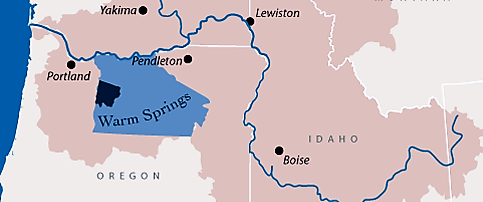
The Columbia River Plateau and Basin provided a rich life for the first people of the region. A dynamic culture flourished along this artery of life. The people shared similar languages, cultures, diets, religions, a history of interaction, and a sharing of common resources and trade. The Columbia River and lands provided salmon, the foothills and mountain slopes were plentiful with deer, roots and berries that sustained a healthy diet.
The Wasco bands on the Columbia River were the eastern-most group of Chinookan-speaking Indians. Although they were principally fishermen, their frequent contact with other Indians throughout the region provided for abundant trade. Roots and beads were available from other Chinookan bands such as the Clackamas. Game, clothing and horses came from trade with Sahaptin bands such as the neighboring Warm Springs and the more distant Nez Perce. In exchange for these goods, the Wasco traded root bread, salmon meal, and bear grass.
The Warm Springs bands who lived along the Columbia’s tributaries spoke Sahaptin. Unlike the Wascoes, the Warm Springs bands moved between winter and summer villages, and depended more on game, roots and berries. However, salmon was also an important staple for the Warm Springs bands and, like the Wascoes, they built elaborate scaffolding over waterfalls which allowed them to harvest fish with long-handled dip nets. Contact between the Warm Springs bands and the Wascoes was frequent, and, although they spoke different languages and observed different customs, they could converse and traded heavily.
The Paiutes lived in southeastern Oregon and spoke a Shoshonean dialect. The lifestyle of the Paiutes was considerably different from that of the Wasco and Warm Springs bands. Their high-plains existence required that they migrate further and more frequently for game, and fish was not an important part of their diet. The Paiute language was foreign to the Wasco and Warm Springs bands, and commerce among them was infrequent. In early times, contact between them often resulted in skirmishes. Although Paiute territories historically included a large area from southeastern Oregon into Nevada, Idaho, and western Utah, the Paiute bands which eventually settled at Warm Springs lived in the area of Lake, Harney, and Malheur counties in Oregon.
During the 1800’s, the old way of life for the Indian bands in Oregon was upset by the new waves of immigrants from the east. In 1843, 1,000 immigrants passed through The Dalles. In 1847 there were 4,000. By 1852, up to 12,000 settlers were crossing Wasco and Warm Springs territories each year.
In 1855, Joel Palmer, superintendent for the Oregon Territory, received his orders to clear the Indians from their lands. He did so by negotiating a series of Indian treaties including the one establishing the Warm Springs Reservation. Under the treaty, the Warm Springs and Wasco tribes relinquished approximately ten million acres of land, but reserved the Warm Springs Reservation for their exclusive use. The tribes also kept their rights to harvest fish, game and other foods off the reservation in their usual and accustomed places.
Traditional ways of life changed greatly after the Wasco and Warm Springs tribes relocated onto the Warm Springs Reservation. Salmon wasn’t as plentiful as it had been on the Columbia, and the harsher climate and poor soil conditions made farming more difficult. They quickly found that their former economic system was no longer workable. In addition, federal policies to assimilate the Indian people forced them to abandon many of their customary ways in favor of modern schools, sawmills, and other infrastucture foreign to the tribes
The settlement of the Paiutes on the Warm Springs Reservation began in 1879 when 38 Paiutes moved to Warm Springs from the Yakama Reservation. These 38 people, along with many other Paiutes, had been forced to move to the Yakama Reservation and Fort Vancouver after joining the Bannocks in a war against the U.S. Army. Eventually more of them came, and they became a permanent part of the Warm Springs Reservation.
In 1934, Congress passed the Indian Reorganization Act (Wheeler-Howard Act) to revitalize Indian communities and to bolster Indian tribes as governments. The IRA recognized the necessity for tribal governments to manage their own affairs, and offered Federal assistance to tribes organizing under its provisions. The Warm Springs, Wasco, and Paiute tribes studied the IRA carefully before deciding to accept its terms.
In 1937, the three tribes organized as the Confederated Tribes of the Warm Springs Reservation of Oregon by adopting a constitution and by-laws for tribal government. In 1938, they formally accepted a corporate charter from the United States for their business endeavors. These organizational documents declared a new period of tribal self-government on the Warm Springs Reservation.
October 20 – January 7, 2017
June 23 – September 10, 2016
Lillian Pitt is a member of the Confederated Tribes of Warm Springs. Lillian is an acclaimed artist known for her ceramic “Stick Indian Masks.” Lillian creates contemporary works of art that delights today’s art lovers, yet honors the history and legends of her people. This is an absolute “must see” exhibit!
